- Eating fat, protein, or vegetables before eating carbs can slow blood sugar spikes. I read that in a book decades ago, and it’s a pattern that Carol and I follow in our everyday meals. When possible, well, we just don’t eat the carbs. Works.
- If you have any desire to look at or find something in Turbo Technix (the magazine Borland paid me to create and edit for six issues before laying us off) it’s here, all six issues, in PDF format. We had a seventh issue complete and in flats, but the end came before we could publish it.
- If you need to do OCR on a .jpg file, you might try OCR Online. It’s free, but it makes you wait for several seconds before starting to work on each image, thus making massive use of the free site impractical. You can buy a subscription for $30/month, or a lifetime subscription for $80. Worked well for OCRing some text out of a Visual Developer issue from which I’d scanned a couple of pages.
- Hans Schantz posted a link to James Macleod’s Truth Decay Substack page about the hidden Internet—which is hidden because Google doesn’t make any money bringing back its pages from searches. I did a test, looking for “Jeff Duntemann” on Google and then on a site called Marginalia Search—and discovered that Marginalia brought back a lot of mentions of me that I’ve never seen before, on Google searches or anywhere else. It’s a long article but worth reading top to bottom.
- My friend WA4GIM sent me a link to a WordPress blog by Dave Richards AA7EE….in 2014. And I never cited it here on Contra, whoops. (That was a kind of busy time for me, moving back to AZ. And there’s still old email piled up…) The site is about homebrewing ham gear, especially kits, and what’s remarkable is the quality of the photos, and the discussion about kits, their quality, and their operation. Go take a look.
- I stumbled across a short essay on how a nuclear explosion at the sea bottom would proceed—and it was not what I thought. Don’t be swimming above the bomb—but what kills you isn’t radiation or a fireball.
- And after reading that item, I fell upon another one. When I was 15 (1967) I wrote a story about a starship with a new hyperdrive that allows it to go so fast that it circumnavigates the cosmos and returns to Earth from the opposite direction. “A Straight Line Is the Shortest Distance” was the first SF short story that I ever wrote. (It was never published.) But the story gimmick that I freely admit I pulled out of thin air may in fact be the way the universe works. (Alas, the story has been lost, or I might post parts of it if they don’t make me laugh too hard.)
- Popular Science has a section called “That Time When,” a collection of stories about weirdness in science and human culture generally. I’d heard of several of the topics, like the dancing plague of 1518. Perhaps the weirdest—one I hadn’t ever heard of—was “Lewis and Clark’s mercury-laced poop helped archaeologists trace their expedition.” Read ‘em all: They’re short and more interesting than I had expected.
Odd Lots
Flashback: I’ve been to Distraction on a Thing with No Name
Decades back (in the early 80’s, I think) I got a late evening call from my friend and SF writer Nancy Kress. She was something close to frantic.
“Jeff! You gotta help me!”
“Anything, Nan.” Far be it from me to leave a beautiful woman in a bad situation.
“Then quick: What do they call that tubey thing that pulls screen doors closed when you let go of them?”
Ulp. She could have asked me how to do I/O redirection under DOS. She could have asked me whether Millard Fillmore had ever been on a US postage stamp. She could have asked me the atomic weight of Ruthenium. But no: She asked me for the name of a Thing With No Name.
Not a horse. A thing.
So tell me: What is the name of that long aluminum hydraulic gizmo that hisses coming and going and needs to be propped open with that little skewed iron washer that always lets go just when you’re heading out the door with the old dresser that must not be scratched? I doubt you’ll do any better than I did. Sheesh; I could go out in the garage and build one for you—but I can’t tell you what it’s called.
Nan and I finally decided that knowing precisely what it was called wasn’t germane to her story—a little item called “Out of All Them Bright Stars,” which went on to win a Nebula award for her—so we did the best we could and called it a “door closer.” That was its job, after all, scratched dressers notwithstanding.
The following weekend I went down to Ace Hardware and prowled the aisles until I found a blister-packed replacement unit hanging on a peg. It was…drum roll, please…a door closer.
I was shattered. Surely it was a wheezyank or a tugtube or an Albemarle cylinder. Could there possibly be something that exists by the tens or even hundreds of millions around the country that has no name, and thus drives people to do the obvious and punt with so boring an appellation as…door closer?
Yes, there is. And by paying attention since then I’ve run into a few of the others.
One is a dog thing. Back when we lived in Rochester, New York I was sitting on the couch, watching Mr. Byte squirming around on his back on the living room floor, rubbing his nose on the carpet while making a don’t-bug-me-I’m-heavily-involved sort of noise halfway between a groan and a growl. It occurred to me that I had watched every other dog I had ever owned do exactly the same thing: Rebel, Yankee, Smoker, and now Mr. Byte. This was obviously Important Dog Behavior, at least as important as peeing on things when you’ve long since run out of pee. So what the hell was he doing? There was no word for it, so I made one up: He was schnauzing. From the German for "muzzle." What schnauzers do. And all other dogs as well.
Fits, doesn’t it? Now, please use this word every chance you get so that I can be cited in the Oxford English Dictionary as the person who coined it.
Moving further out into the realm of abstraction, there is the problem that in English we have no single word for “it is to be hoped that…” Most people probably don’t lose a lot of sleep over this one, but it does bother me. I used to admire the French for their terseness, after Sister Agnes Eileen explained to us in third grade that the last Tuesday before Lent was called "Mardi Gras" in French. As she put it, “‘Mardi’ means ‘Tuesday,’ so ‘Mardi Gras’ means ‘the Tuesday on which meat may be eaten.’” Junior logician that I was, I unrolled the syllogism and assumed that “gras” in French meant “on which meat may be eaten.” A dinner plate was thus an “assiette gras,” as was someone’s upper plate, which most certainly is an artifact with which meat may be eaten. Don’t tell me that “gras” means “fat.” Sister wouldn’t lie. Maybe you got the accent marks wrong.
So although I seek in vain, others in my condition have done the obvious thing and stolen another word that isn’t used nearly as often: hopefully. Now, this word really and legally means, “with hope in one’s heart,” as in, “Expecting some word about her order, she rummaged hopefully through the day’s mail.” That is, she rummaged through the mail, filled with a feeling of hope that PC Nirvana will finally either ship her damned mouse or send her a refund.
Desperate word hijackers have taped hopefully’s mouth shut to muffle its screams and begun using the word to mean “it is to be hoped that…” as in, “‘Hopefully, my mouse will show up tomorrow,’ she said, wiping the blood from her arrow keys.” Complain though purists might, the crime’s been committed, and the Law of Conservation of Syllables has been satisfied. Besides, people rarely use the word “hopefully” to mean “with hope in their hearts” anymore, especially when they’re dealing with mail order computer retailers.
Finally, there is what I can only assume is a Jeff thing, because I have never seen or heard anyone else encounter it. It’s a Jeff thing in part because I keep my money loose in my right pants pocket, whereas most people keep theirs in a wallet. When I was fourteen I lost my wallet, and it had the $10 bill in it that I had received for Christmas from my godmother Aunt Kathleen. This cauterized me for all time on the issue of placing so vulnerable a substance as money in so losable a container as a wallet, which hangs precariously off your butt in the embrace of a loose fabric attachment that is far wider (but never deeper) than it needs to be. (Remember, when I was fourteen, $10 was way more money than it is today.)
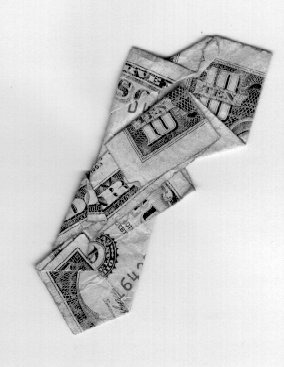 The Jeff thing in question is what to call the bills that have been sitting in the bottom of your pocket for several weeks. Cash always begins its life in a nice tight roll, but as you peel off a crisp 20 and hand it to the guy at Taco Bell, he hands you back a tatterdemalion wad of greasy ones and fives, which join their fellows in the bottom of your pocket, wrestling and twisting and doing everything but (sigh) reproducing.
Years’n’years ago, before there were ATMs, I went too long without cashing a check, and finally had the occasion of pulling the very last bill out of the bottom of my pocket. It was a remarkably shaped thing indeed, a $10 bill that had spent time in the arms of the Muse, and emerged as something one might call “wealth art” with something approaching (but not achieving) a straight face. Hell, call it whatever you want to; I call it moneygami.
Everything should have a name. If you spot something without a name, give it one quickly, before somebody decides to call it a door closer.
Not entirely sure when I wrote this; I think 2004 but it might have been later. It was too big to put on Contra back then, so I posted it as a separate article on my site.
50 Years of Our Lives Shared in Marriage

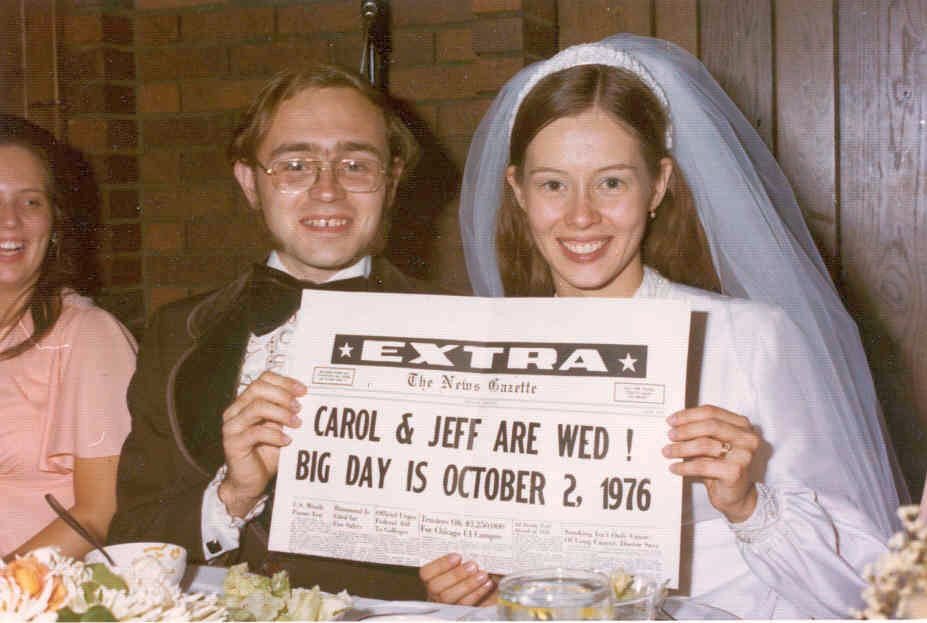
Fifty years ago today, Carol and I clasped hands at the altar of St. John Brebeuf Church in Niles, Illinois, and spoke our vows, each to the other:
My beloved, over these past seven years you have become my best friend. By these words we are one, and let this path we are beginning have no end.
I promise always to listen, for you have much to say and I have much to learn.
When there is conflict I will compromise; when there is triumph I will rejoice.
When I err I will ask forgiveness. When you ask for forgiveness I will forgive.
Let my embrace be your refuge. Your touch will be my peace.
I give you all I am, in the hope that you may become all you can be.
All of these promises have been kept, in both directions. Our secret? We met when we were young (16 and 17), and built our shared lives on a transcendent friendship that emerged slowly from conversation, respect, kindness, and a strong desire to share time and (eventually) our lives with one another. We talked, we took walks, we flew kites, we danced (she is a spectacular dancer—and I tried my best) went to movies, concerts, plays (including one that she was in!), picnics, family dinners, and had quiet evenings of conversation while the music of our vinyl albums played on the family stereo. We kissed and we cuddled, but did not let lust dominate our feelings for one another. We spoke in depth about marriage and shared lives, and in 1975 we proposed to one another on a bluff in Wisconsin overlooking the Mississippi river. It took a year to get our wedding together, but we got there, in high style.
Fifty years later, we have never been more in love, more committed to one another, and more grounded in unshakable friendship. I call friendship the cornerstone of the human spirit because it is (and has long been) the cornerstone of our lives together. Our lives continue, and we will celebrate each year that passes as we celebrate today, savoring our memories and looking forward to as much life as by God’s grace we may share, here and hereafter.
To life, love, and friendship! 50 years is only the beginning!
Odd Lots
- Excellent article by Brian Niemeier about the recent Amazon scam of using AI to create novels supposedly by a (reasonably) successful author, stealing that author’s name for publishing and promotion. Creepy, totally dishonest stuff, one that will not make AI popular among honest authors.
- Windows Recall is a terrible idea: It takes regular snapshots of your screen and stores them (supposedly) on your mass storage drive. I’m not sure this is useful, and I think it’s…suspicious…that newer Windows desktops and laptops have it pre-installed. If you want to get rid of it, this article explains how. It’s not hard and not especially technical. Be sure to read through to the end of the article.
- Here’s a page highlighting paper models of every polyhedron I’ve ever heard of, and no small number that I haven’t. They’ll also give you templates for cutting out your own polyhedrons. It fun lots is of.
- Everything you probably never wanted to know about stink bugs. I’ll add the asterisk that I’ve never seen one in Arizona.
- New research shows that caffeine triggers DNA repair. I’d like to see more research, but lord knows I like coffee and almost always drink two cups a day. (Any more and it would interfere with my sleep. Your mileage may vary.)
- I take zinc and quercetin every day to protect against colds and flu. It’s worked very well for me, at least with colds. (We caught COVID a couple of years after the virus’s heyday, but it was less annoying than an ordinary cold.) The downside to zinc is that it leaches copper out of the body. I take a multivitamin with copper, and eat cashews, which are the tree nuts with the most copper. So far so good.
- Both Tom Leher and Weird Al Yankovic now have asteroids named after them. Rock music, anybody?
Advice from an AI on YouTube
I don’t watch TV much, and haven’t for quite awhile. It’s a bad use of my time, and never more than recently, when a friend sent me a link to a YouTube group called Isabella Advice. The link was to a video on prostate health, which is a topic of considerable (if fairly recent) interest of mine.
Well. What we have is a video of Isabella, a pleasant-looking forty-ish African American woman who says she’s an MD. It’s a 24-minute video, and I watched it to the end. By the time I reached the end, I knew the truth: The video was generated by an AI, and although the advice was fairly sound (and mostly aligned with the rest of my research) the presentation was a little, well, freaky.
What I noticed first were her hand gestures. There were five or six variations, but each variation was used identically many times during the video. She raises her hands to the same height, sometimes alone, sometimes clasped, sometimes just rising at once without touching one another. Her hands remained in her lap unless she was raising them, and the position of her body didn’t change except for a very slight up-an-down bounce. I’ve seen enough videos to know that presenters rarely sit this odd sort of stock still—not for 24 minutes, at least.
There are captions of what she’s saying, and her voice is good, if a little monotonous. But then…the caption contained a weight, something like 20 lbs. She didn’t say “twenty pounds.” She said, “twenty ell-bees.” Later the caption read ”with your daily 30-inute” with the initial “m” missing, and that’s precisely what she said, “thirty in-oot.” (It’s at 16:35 in the video.) She was literally pronouncing typos.
That nailed it. I’m guessing that someone who knew something about prostate health wrote a script, and the AI voice read it mercilessly verbatim.
When I’ve watched YouTube, it’s usually because somebody is doing something visual and explaining it: crafts, ham radio, building electronic projects, robots, telescopes, and so on. The visual focus isn’t 100% on the presenter. I could have read what the AI was saying in probably five or six minutes. For the most part, I research by reading, unless there are necessary graphics. Watching an AI sitting in a chair reading a script for half an hour is truly a waste of my time. I won’t do it again, but I’m going to watch for other examples of AI in use, not just on YouTube but anywhere else I run across it. If I spot any, you’ll read about them here.
Odd Lots
- Ok, it’s weird: Ice cream in the shape of a fried chicken leg. But it’s really ice cream. The meat is ice cream, the bones are chocolate, and the breading is made of broken but not powdered corn flakes. When I first saw it I thought: Fried chicken flavored ice cream? Whew. No.
- And if you thought fried chicken shaped ice cream was weird, consider the Republic of Slowjamistan.
- Peanut allergies and the resulting deaths were almost unknown before 1980. So what happened? Here’s a piece with as good a theory as I’ve ever seen. Carol and I eat non-emulsified peanut butter sold in glass jars, and whole peanuts. Never had any trouble, granting that we ate peanuts as fairly young kids.
- No Atlantic hurricanes this year so far, breaking a 60-year record. (More here with better graphics.) If no little spinwhizzies show up by September 22, it’ll break an 85-year record. If we don’t see any by the close of hurricane season on November 30, it’ll only be the third time on record this has ever happened. (The first two were 1907 and 1914.) Asterisk: In 1914 we didn’t have satellite cameras and so there may have been a few mid-ocean that we never knew were there.
- How will AI destroy the human species? It’ll tell everybody that they’re already dead—and everybody (but me) will believe the damn things.
- It had to happen eventually, and it just happened a few minutes ago: I was reading a substantial 700-page hardcover book that was very absorbing and addressed some issues that interest me intensely (more about this after I finish the book) when, without thinking, I touched my index finger to the page I had just finished and swiped left. Whoops.
Review: The Commons Captured by Michael J. Bommarito II
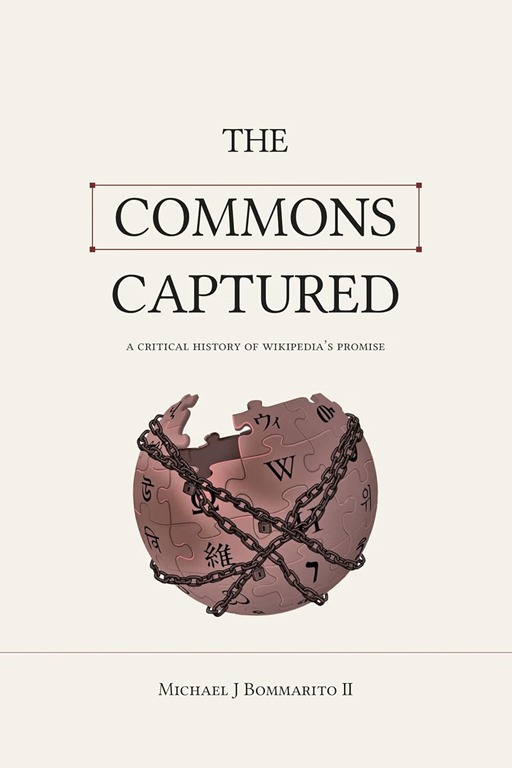 I’ve had an eye out for a history of Wikipedia for some time, and the other day stumbled across The Commons Captured, by Michael J. Bommarito II. And yes, it does provide a reasonably detailed history going back to Wikipedia’s origins in 2001. But that’s not really the book’s focus, as the title suggests.
In addition to the history of Wikipedia, the book provides a history of what Richard Stallman created and called “copyleft:” a system of licensing that provides intellectual property for free, with the caveat that all derivative works maintain the price tag of $0.00. It’s the Creative Commons, along with ShareAlike, generally abbreviated as CC BY-SA, now at version 3.0. (See this link for details.) I released my Free Pascal from Square One ebook under CC BY-SA 3.0. From a height, this means that you can share it, pass it around, and borrow parts of it for your own projects, but you cannot sell it. This is the license that supposedly surrounds Wikipedia and its (now) seven million articles. And it worked great for over 20 years.
Then alluvasudden AI happened, and everything changed.
That’s the book’s focus: How AI took advantage of Wikipedia’s freeness, and how the powers that operate Wikipedia broke Creative Commons and licensed Wikipedia’s content to AI companies…for money.
Really. Wikipedia’s operators created the Wikimedia Foundation as a licensed nonprofit. AI tech firms had begun training their AIs on Wikipedia’s content almost as soon as there were AIs, without paying or asking permission. Hey, reading Wikipedia is free, right? So why not? Well, because the AI companies sold access to their AIs to the public for money. And having digested Wikipedia’s seven million articles, those AIs began answering questions from AI firms’ customers using Wikipedia’s content.
The Wikimedia Foundation created a licensing system that offered a license to AI firms. Many (but not all) of the AI firms paid money—big money—for the right to train their AIs on Wikipedia’s content. Granted, it takes money for servers to host something as big and as popular as Wikipedia. But the Foundation brought in way more cash from licensing AI training than it needed to keep the servers pumping.
The real bummer is that Wikipedia’s articles are written and edited by volunteers who pocket nothing for their time and effort. And none of that license money ended up in those volunteers’ pockets. None. Also, as more people hooked up with AI, fewer people went up to read Wikipedia itself.
So what’s the end of the story? Well, the story hasn’t ended. Michael Bommarito sketched out four possible outcomes of the AI licensing issue over the coming years, but he isn’t optimistic, and I won’t summarize those here. Buy the book.
What I found most fascinating was the gray haze that still surrounds the issue of what AIs store, how they store it, and whether or not training AIs falls under the legal category of fair use. Wikipedia is not copyrighted, but copylefted, so that shouldn’t matter. But…the Foundation is selling Wikipedia access to the AI firms, who sell access to their trained AIs to a (mostly) paying public. So much for copyleft.
The book is very well-written but dense, and demands close attention. I found it puzzling that the book makes no mention of Justapedia, which is a very good Wikipedia fork that I use and may someday (as time permits) attempt to write some articles for. The book does mention Grokipedia and Everipedia, though not at length. So I’ll keep looking.
But if you’re interested in the emerging legal issues surrounding AI training, this is definitely the book to read.
Homage to the Ace Double
Like me, they were born in 1952. Unlike me, they died in 1978, though in truth I don’t remembering seeing them after I got out of high school in 1970. The Ace Doubles were two short novels in a single mass-market paperback volume. Back when I was in high school 1966-1970, they cost 60c, and I usually bought them at the long-gone Arcade Bookshop, which was in the basement of the strip mall at Harlen and Foster Avenues in Chicago, almost under the Walgreen’s there. Some were westerns. Some were mysteries. But I think most were SF. Here’s a list.
 I bought a lot of them. I have two left. My favorite will always be Destination Saturn by David Grinnell and Lin Carter, 1967. Its bookmate, Invader on my Back, by Philip E. High, was…so-so. Some of the others I judged as unreadable and threw away; a lot of them just fell apart after I read them a few more times. I’m sure I loaned several to friends and forgot to ask for their return. It doesn’t matter. Once I cleaned out all the SF in my local public library, the Doubles got most of my money and attention. They definitely shaped my early understanding and appreciation of SF. They were not great fiction, but that didn’t matter to me because as a high-school freshman I had very little to compare them to. When I was 14 or 15, they were just dazzling. The covers were sometimes better than the novels themselves, especially after I was older and had read a lot more of much better SF. (The above cover is a Kelly Freas.)
So. Zoom forward from 1971 to 2011. I launched the drumlins stories in 2002, with “Drumlin Boiler” in IASFM. I had begun The Everything Machine in 2006, but didn’t finish it for another 19 years. (Long story, and the long story is not the novel, heh.) I had a concept for a drumlins novel that didn’t have to be monumental. I offered my good friend and author Jim Strickland a chance to write a drumlins novel of his own. At some point in 2011, we got the idea of publishing them together, both in a single volume.
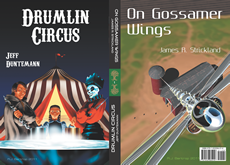
Then it hit me: We could publish a double SF novel as homage to the Ace Doubles. How? It’s called tête-bêche, which is French for “head-to-tail.” The two novels are published back-to-back, but one is upside-down with respect to the other. Both have covers. The best way to explain this is simply to show you the tête-bêche cover image we used for our double:

The cover was the easy part. It was much tougher to build a complete PDF of the text with half the book upside-down with respect to the other, and pages in reverse order. Jim figured it out, and the body PDF happened.
I published the paperback on Lightning Source (now owned by Ingram) and a few copies were sold before they canceled the book for lack of sales. However, we knew that the ebook market was catching fire, so we (mostly Jim) created an ebook edition for Kindle, which was published in April 2011. I’ve published most of my SF books in both ebook and paperback editions, but 95% of my sales have been ebooks, even back in the teens. So I wasn’t in a huge hurry to publish the paperback double on Amazon. I never expected to sell hundreds of copies. But I wanted to publish a tête-bêche paperback volume in honor of the cheap SF books I cut my teeth on when I was a high schooler. Cheap, but novel in their way (heh) and in my opinion, a damned clever format.
Alas, as I found this morning, Amazon won’t accept the paperback for publication. They say they don’t publish “flip books.” Huh? My understanding of flip books is that they’re a way of animating images on paper by drawing images that change slightly on each successive page of a book. You flip through a flip book by placing your thumb on the edge of the book, and pressing the book so that the pages appear rapidly, in sequence, animating the image. The only detail I got about the refusal is that parts of the book (almost half of it, in fact,) are upside-down. Well, yeah—that’s what tête-bêche books are: Books that are actually two separate blocks of text upside-down with respect to one another, and covers on both sides of the book.
So where do we go from here? I’m not sure. My first impulse is to try Lulu.com. I have an account there and published several early books there, including the Carl & Jerry series, which are now on Kindle as paperbacks. I’ll post an entry here if Lulu accepts the book, or if I have to look further and finally find a place willing to sell it onesy-twosy.
Am I nuts? No. I understand completely that the ebook edition of the double novel is what people will buy. But the Ace Doubles left a mark on me, and I’m honoring them with the tête-bêche paperback of Drumlin Circus and On Gossamer Wings. I will sell a few—and these days paperbacks are useful to wave around at convention huckster tables or panels, even if what people end up buying are the ebooks. Watch this space—I’ve gone too far with the project to stop now.
Odd Lots
- Here’s a longish and intriguing article about how our meal schedules affect bodily health. There’s some evidence that morning people eat healthier than night people simply by eating meals earlier. Carol and I jump out of bed a little after 6, and often start dinner at 4:15 PM. Here’s another piece on the topic.
- My friend Pete sent a link to a solid piece on how Internet search worked before Google. I used Alta Vista a lot back then, and had a Usenet login until my ISP stopped carrying it in the late oughts.
- And if you’ve never had a Usenet login and know little or nothing about it, here’s a quick summary.
- An aspirin a day may keep colon cancer from coming back after surgery. They’re still not sure precisely how this works, but as long as it does work, I’m all for it.
- An American PBS affiliate in Denver stored its data in a cloud server. When the cloud server company (not the server hardware company) went under, the PBS affiliate still can’t get its terabytes of TV shows back from the server hardware outfit. I have never liked (nor used) cloud storage, and this is just another instance of why.
- I wasn’t expecting this: Beamforming feedback information (BFI) sent to a router from connected wireless devices like phones, laptops and tablets can be used to generate high-quality images of people within the microwave field used by the local Wi-Fi WLAN installations. The tech is hard to describe, but it generate images of human users detailed enough to identify. Think Flock cameras are bad?
- Some clever scoundrel used a tiny white font displayed on a white background to inject “invisible” (to humans) prompts into an AI working for a court of law in Connecticut. He got caught, but once this trick gets around, it could become a very serious problem.
- Protons are not as simple as they used to be; long ago they were, well, bohring. These days they’re full of valence quarks, baryons, and gluons. Thankfully for us, there’s more matter than antimatter in the cosmos, and scientists hope that this new view of proton anatomy may explain the reason for that precious imbalance.
Odd Lots
- Here’s an easy read about Boom Supersonic’s project to create a supersonic airliner capable of cruising at Mach 1.7 without a significant sonic boom reaching the surface beneath the aircraft. Their target is to deliver aircraft by 2029, though skeptics think that’s overly ambitious because Boom is designing a supersonic-capable engine from scratch. The engine will also be marketed as part of a power-generation system for AI data centers.
- There’s a new ATSC (Advanced Television Systems Committee) standard, ATSC 3.0, which will improve TV image quality, it also includes technology to allow DRM on broadcast TV, encrypting “over the air” signals and turning broadcast TV into yet another form of pay TV. You’d have to buy a new “NextGen” TV to watch ATSC 3.0 content. TV isn’t my thing, but I predict a great deal of bitching and moaning against this possibility. Stay tuned, heh.
- According to recent research, working crossword puzzles for two minutes a day can slow brain aging dramatically. Actually, anything that requires cognitive activity can slow brain aging. One reason I tinker with programming (for me, in Free Pascal/Lazarus) is to keep my mind working. I do a couple of word puzzles on my tablet here and there. Maybe I should do more. What I don’t do is sit in front of the TV all day. Or on most days, even for two minutes.
- The US House has passed a bill making Daylight Savings Time permanent. Umm…didn’t we try this already? We did. Nobody liked it, and it didn’t last long. My response is that we should make standard time permanent, which wouldn’t push dawn to an hour later and force people to start the day in darkness. Yeah, back in Chicago in late December it used to get dark by 5 PM. The kids were home from school by then, and cars for commuters have headlights. Arizona is on standard time all year, and it works fine for me.
- Private collectors are outbidding museums for fossils—right up to Gus, one of the largest and most complete T-Rex fossils ever found. Sotheby’s is selling dino bones to the very rich, some of them earning in excess of $30M. It may gall some people, but even I know that leaving fossils in the ground — especially if they’re exposed to the elements—can cause serious deterioration. One wonders what a billionaire would do with a T-Rex skeleton. In the rec room? Office? Maybe we’ll find out.
- Astronomers have found a species of sugar scattered out in the gas and dust in our galaxy. Sweet!